
Seeing your first 100 visitors is a good moment to look at your site differently. Up to now you have been building without knowing whether anyone would arrive. Now a small group of real people has read some of what you wrote, and their behavior tells you where to put your next hour.
This article explains what to do after your first 100 visitors: what to check, a 30-minute daily routine, a weekly rhythm, and a template you can copy today.
Why 100 visitors is a signal, not a finish line
A hundred visitors is too small a number to prove anything about your site’s future. It is large enough to show you patterns, though. A few of your pages got read and others did not. Some visitors arrived from a search, some from a link you shared, and some probably from you or someone you know.
Treat that as feedback. Each visit is a small answer to the question “Is this useful to anyone?” Your job is to read the answers and adjust, instead of guessing at what readers want.
Two cautions keep the data honest. First, your own visits and those of friends you sent to the site can inflate the count, so the true number of strangers may be lower. Second, a small sample can mislead you. If one page got 40 visits and another got 3, that is a hint about where to look, not a verdict.
If the early weeks feel slow in general, the post on why your online business feels slow in the first months covers that side of it. This article stays practical.
What to look at first: the three things your first visitors can tell you
You do not need a dashboard full of charts. Open whatever stats your site gives you and look for three things only.

1. Which pages got read
Sort your pages by visits. The top page is the topic your early readers cared about most, or the one that was easiest to find. Either way, that is where your next improvement goes, because a page that already has readers repays your effort fastest.
2. Where visitors came from
Look at the sources: search engines, Pinterest, Facebook, direct visits, or other websites. Notice which source sent people to which page. If a Pinterest pin sent most of your traffic, that tells you something different than a page that appeared in search results on its own.
3. What visitors did next
Check whether people clicked through to a second page, or left after one. If your stats show it, note how long they stayed on the page. A reader who visits one page and leaves quickly may not have found what the title promised. A reader who goes on to a second page is telling you the topic holds their interest.
If your articles contain affiliate links, you can also see which ones get clicks. The guide on how to see which of your affiliate links get clicked shows how to do that without paying for a tool.
Write down your findings in two or three plain sentences, for example: “The beginner’s guide got the most visits. Most came from Pinterest. Few people clicked to another page.” That note is your starting point for everything below.
A 30-minute daily loop you can actually keep
A routine you can finish on a busy day beats an ambitious one you abandon by Thursday. This loop takes 30 minutes and has four parts, always in the same order.

- Look (5 minutes). Open your stats. Check which page got the most visits since yesterday and whether anything new showed up. Do not analyze, just notice.
- Improve one thing (10 minutes). Pick your most-visited page and make one change to it. Rewrite a weak introduction, add a clearer heading, fix a typo, add a link to a related post of yours, or answer a question a reader would likely have next.
- Share one thing (5 minutes). Post one pin on Pinterest or one post in a Facebook group or on your Facebook page. More on this below.
- Write the next post (10 minutes). Spend the last block drafting. Ten minutes will not finish an article, but it produces an outline, a few paragraphs, or a list of questions the post should answer.
The order matters. Looking first means your improvement and your sharing are based on what readers did, not on a mood. Writing last means the new post gets the knowledge you just gathered, and it also means that on a rushed day you can drop the writing block and still have done the three most useful tasks.
One improvement per day is a deliberate limit. If you try to fix everything at once, you cannot tell which change helped. Small changes, one at a time, let you notice what works.
The weekly rhythm: one new piece, one update, one share
The daily loop produces small movements. The weekly rhythm turns them into finished work. Over seven days, aim to complete three things:
- One new piece. Your ten-minute writing blocks add up to a full draft within a week, often with a bit of extra time on one day to finish and publish it. Choose the topic from what your top pages told you. If readers liked a beginner’s guide, write the next question a beginner would ask.
- One update. Choose a published post and give it a proper revision: tighten the opening, check that every link works, add a section that answers a question you think readers have. Your daily improvements can feed this, so by the weekend you may already have the update half done.
- One share that matters. Beyond the daily post, pick the best page of the week and give it a bit more effort: a well-made pin with a clear title, or a thoughtful Facebook post that explains who the article helps.
Pick one day for a ten-minute weekly review. Look at the week’s stats against your note from the first day and write one sentence about what changed. That sentence decides what you write about next week.
If you want ideas for bringing in more readers once this rhythm is steady, how to get your first 1,000 visitors without paying for ads is the natural next read.
Where Pinterest and Facebook fit into the routine without taking over your day
Social platforms are easy to overuse. You can spend two hours on them and feel busy, with nothing new on your site. Giving them a fixed slot of five minutes in the daily loop keeps them in proportion to the writing, which is what builds your site.
On Pinterest, a pin is a picture with a title that links to one of your pages. Make or choose one image for one page, write a title that says plainly what the reader will get, and link it to the matching article. Pins stay on the platform after you post them, so they can keep sending visitors without further work from you.
On Facebook, share a page in a group or on your own page only where it is welcome and useful. Read the group’s rules first, since many limit links. A post that answers a question someone asked, with your article as the longer version, is better received than a bare link.
Use your stats to decide which platform deserves attention. If one has sent visitors and the other has not, share there a bit more often. Keep the time limit anyway. If one platform keeps sending readers who leave right away, the problem may be the page rather than the platform, and your daily improvement block is where you fix it.
When the numbers stall: how to adjust the routine instead of abandoning it
Some weeks the visit count will not move, or will fall. That is normal for a new site, and it is rarely a sign that the routine failed. It is a prompt to change one part of the loop.
Work through these in order:
- No new visitors at all. Check that your recent posts are published and that your shares actually linked to the right pages. A broken link is common and easy to fix.
- Visitors arrive but leave quickly. Revisit the page’s title and opening paragraph. Does the opening deliver what the title promised? Improve that before writing anything new.
- One post works, the others do not. Look at what is different about the successful one. It may cover a narrower question, use clearer headings, or have been shared in a better place. Write your next post in the same style.
- You are too tired for 30 minutes. Shorten the loop to 15 minutes by keeping only the look and the share, and skip the writing block for a week. A smaller routine you complete is better than a longer one you skip.
Change only one thing at a time, then give it two weeks before judging. A site with a few hundred visits does not have enough data to react to day by day.
Your first routine, written out: a simple template to copy and adapt
Copy this into a notes app or a notebook. Adjust the times to fit your day.
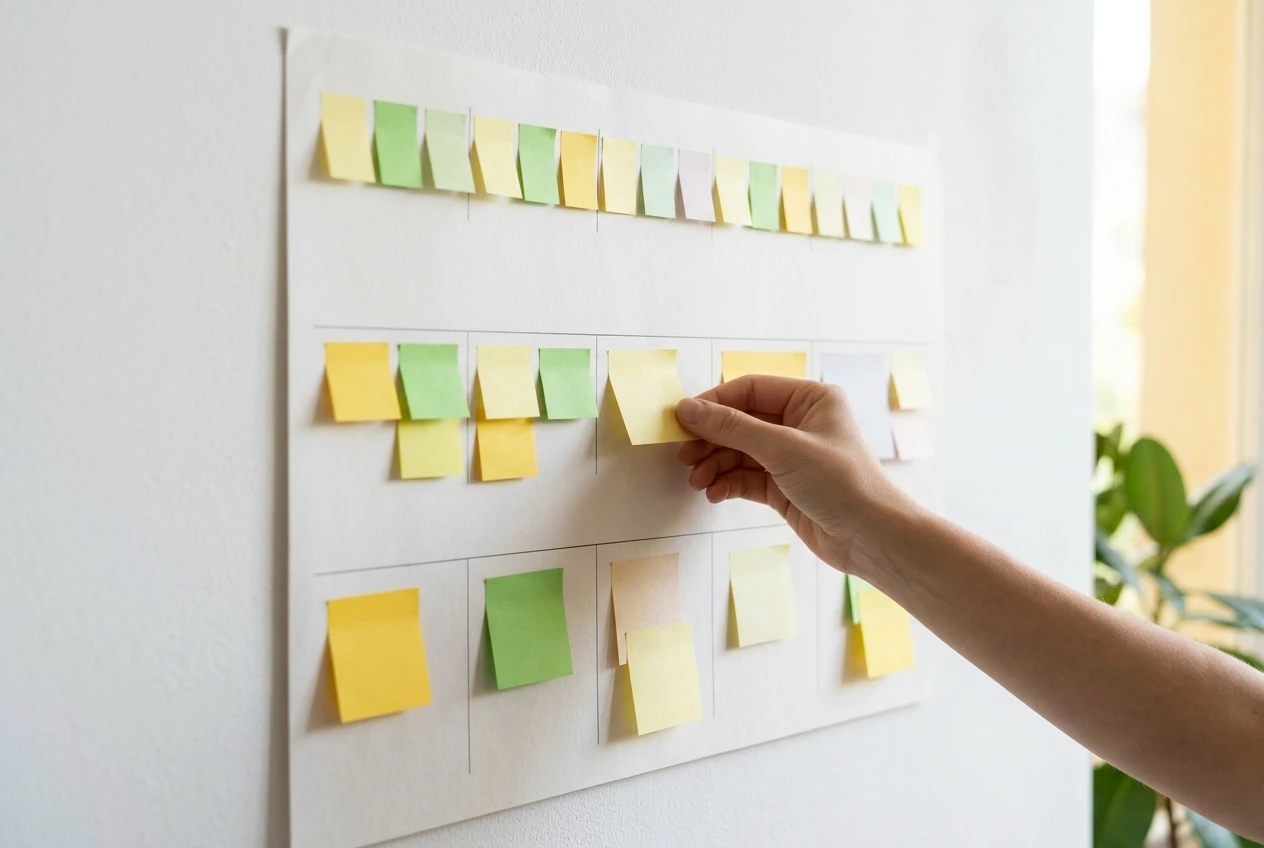
Daily (30 minutes)
- 5 minutes: check stats for top page, top source, and anything new
- 10 minutes: make one improvement to your most-visited page
- 5 minutes: post one pin or one Facebook share
- 10 minutes: work on the next post (outline, draft, or research)
Weekly (one sitting for the review, the rest folded into your daily blocks)
- Publish one new piece
- Revise one existing post
- Give your best page of the week a stronger pin or Facebook post
- Spend 10 minutes comparing stats with last week and write one sentence on what changed
Monthly (30 minutes)
- List your top three pages and top two traffic sources
- Decide on the topic of your next four posts based on that list
- Remove or change anything in the routine you are not keeping up with
Your first 100 visitors showed you something about your site. Following this routine, you will learn more with each page you publish, and you will have a record of what worked.
If you’d like a place to practice this routine with training and a friendly community beside you, read my About page to see how I use Wealthy Affiliate, and take a look around at your own pace.