
Most beginners run into the same handful of affiliate marketing mistakes in their first months. They happen because nobody hands you a map when you start, so you guess, and some of the guesses cost you time. None of them is permanent, and none requires tearing down what you’ve built. Each has one small correction you can make this week.
You’re not behind: why almost everyone makes these mistakes
Online business looks simple from the outside: pick something to promote, put up a website, share links, get paid. The parts nobody shows you are the slow, ordinary ones, like building trust with strangers, writing the same kind of article many times, and waiting for search engines and readers to find it.
Because those parts are invisible, beginners fill the gap with guesses. They promote too soon, copy what looks busy, or conclude after a few weeks that it doesn’t work. These are reasonable guesses from someone who hasn’t seen the whole picture yet.
If you recognize yourself in more than one of the mistakes below, you are in the normal range. The fixes are small adjustments to what you are already doing. Pick the one that fits you best and start there.
Mistake 1: Promoting products before anyone trusts you
A new visitor knows nothing about you. If the first thing they see is a button telling them to buy something, they have no reason to believe you, and they leave. Pages built mostly of links and sales language tend to lose people quickly.
Trust comes from usefulness. When someone reads an article that answers their question clearly, they start to treat the site as a source. After that, a recommendation from you reads as advice and not as an advertisement.
This week’s fix: Open your most link-heavy page and add a real answer above the first link. If the page recommends a tool, explain who it suits, who it doesn’t suit, and what the reader should check before deciding. Honest limits make a recommendation more believable. Also read the pages of your site as a stranger would, and check that your About page says who the site is for and what they will find.
Mistake 2: Picking a niche you can’t write about for a year
Beginners often pick a niche because it looks profitable, then discover around article eight that they have nothing left to say. Others pick something so broad that every article feels like a different website. Both problems come from choosing a topic without testing whether you can keep writing about it.
A good first niche has three things: people with a real problem, a range of questions you could answer for a long time, and some interest from you, even a mild one. You don’t need to be an expert. You need to be willing to research and explain.
If you are still weighing options, How to Choose Your First Niche Without Overthinking It walks through the decision in plain steps, so there’s no need to repeat it here.
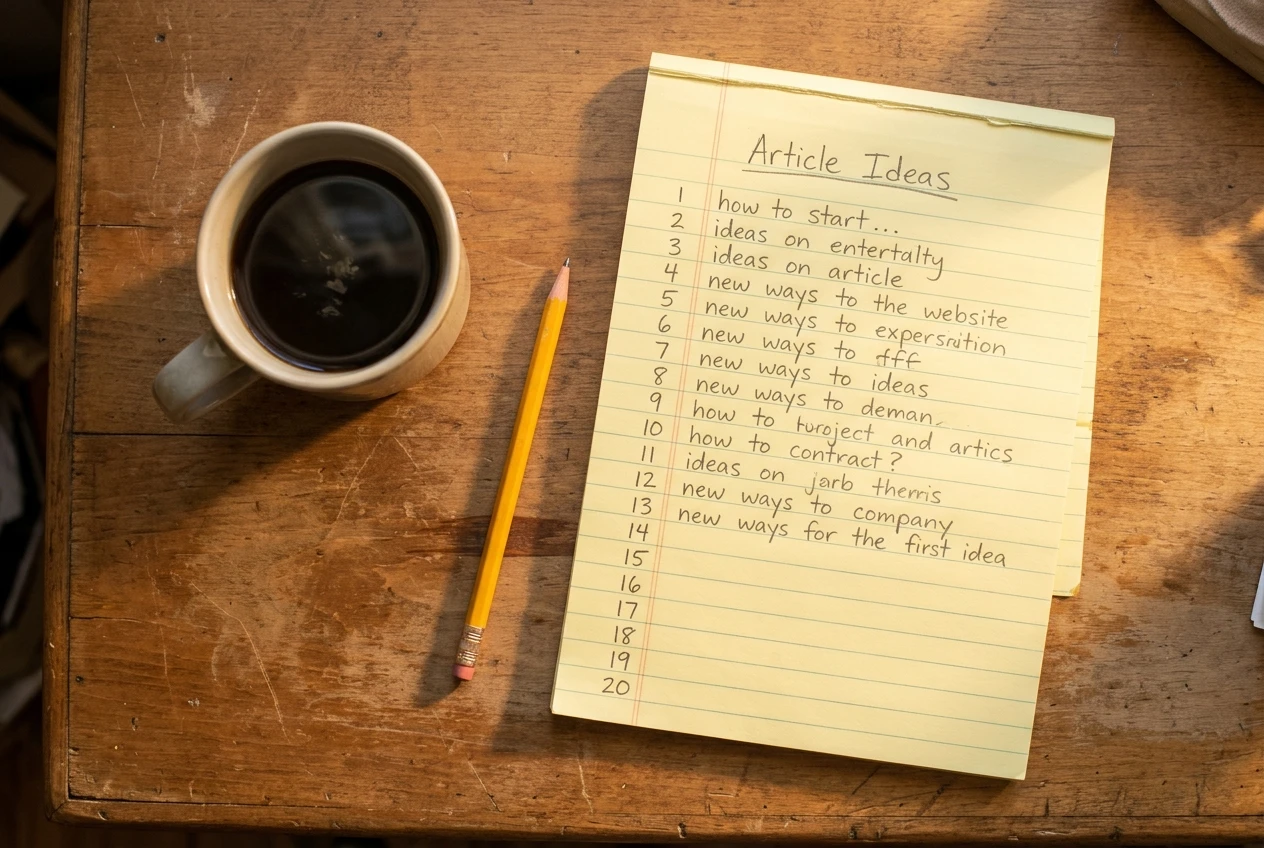
This week’s fix: Write down 20 article titles your niche could support. If you reach 20 without straining, the niche is workable. If you stall at eight, don’t delete your site. Narrow the audience, or adjust the topic until the list comes easily, and keep the content you have already written where it still fits.
Mistake 3: Writing for search engines instead of a real person
Keywords matter, since they tell you what people actually type into search. The trouble starts when the keyword becomes the whole point of the article. You get a paragraph that repeats the same phrase four times, a sentence that exists only to contain it, and a page that reads as if no human wrote it.
Readers notice this immediately, and search engines have grown steadily better at noticing it too. A page that answers the question completely tends to serve both.
The better approach is to choose one question a real person is asking, then answer it as you would to a friend sitting across from you. Use the keyword where it fits naturally, in the title, in an early paragraph, and in a heading or two. Everywhere else, use ordinary wording.

For a fuller look at what makes writing useful to a reader, see how to write content that actually helps your reader. It is written for people who have never published online before.
This week’s fix: Take one existing article and read it aloud. Any sentence you would never say to another person, rewrite or delete. Then check that the article answers its main question within the first few paragraphs, so the reader doesn’t have to hunt for it.
Mistake 4: Expecting income in the first few weeks
This is the mistake that ends the most projects. A beginner publishes some articles, checks the earnings page every day, sees nothing, and decides the whole idea was a mistake. Often they stop shortly before the work would have started to show.
Content on a new site generally needs time before it is found. Search engines have to discover your pages, and readers have to find them, trust them and come back. During that stretch the site can look like it is doing nothing even though it is gradually building a base of pages that can earn later. No one can promise you a date for your first commission, and anyone who does is guessing.

What you can control is how much you publish and how good it is, and those are better things to measure in the early months than money.
This week’s fix: Replace the daily earnings check with a weekly activity target you can actually meet, such as two finished articles. Write it somewhere visible and tick it off. When the habit is steady, you are doing the work that income depends on, and you can see that progress even when the earnings page is still empty.
Mistake 5: Hiding or skipping your affiliate disclosure
Some beginners worry that telling readers about affiliate links will scare people off, so they leave the disclosure out or bury it where nobody will find it. This is a mistake for two reasons. In many countries, including the United States, rules require you to make clear when you may earn from a link. And readers respond better to openness than to discovering the link later.
A disclosure does not need to be long or apologetic. It should say plainly that some links may pay you a commission if the reader buys, and that this doesn’t cost the reader extra. It should sit where people will see it, not in tiny text at the bottom of a page.
You can also keep a dedicated page for the full wording. Mine is the affiliate disclosure page on this site, and a link like that from your footer and from relevant articles gives readers somewhere to check.
This week’s fix: Do three things. Add a short, clear disclosure line near the top of any post containing affiliate links. Create or update a full disclosure page. Link to that page from your menu or footer. Check your local rules if you are unsure what applies where you live, since they differ by country.
Mistake 6: Trying to be everywhere at once
A new site, a Pinterest account, a Facebook page, an email list, a video channel: it is tempting to start them all in the same week because each one is described as essential. The result is usually thin effort across many places, with nothing strong enough anywhere to bring in visitors.

A calmer order works better. Make your website the home base, since that is where your articles and your trust live. Then add one traffic source and give it enough time to show whether it works for you. Pinterest and Facebook can both send readers to a site, and neither does it well if you post irregularly and abandon the account after a fortnight.
If you want a starting point that costs nothing, How to Get Your First 1,000 Visitors Without Paying for Ads covers free ways to bring people to a new site.
This week’s fix: Choose one channel besides your website and pause the rest. Set a small, repeatable routine for it, such as sharing each new article once with a clear, useful description. Revisit the decision after you have a month of consistent posting to look at, not before.
Mistake 7: Skipping the basics of how you actually get paid
Many beginners join a program, place a link, and never learn how commissions are tracked, when they are confirmed, or what counts as a qualifying action. Then a question comes up, such as why a sale doesn’t show or when a payment will arrive, and they have no framework for answering it.
Knowing the mechanics makes you calmer and makes your content better. You can describe the process honestly to your readers, and you can tell the difference between a normal wait and a real problem.
For recurring programs the picture has a further detail. Wealthy Affiliate’s referral commissions continue for as long as each referral stays subscribed, which means the long-term value comes from the people you help, and from them staying satisfied. That rewards patience and honest recommendations over quick, one-off pushes.
The full walkthrough is in how affiliate marketing commissions actually get paid, step by step, so you can read the details once and keep the basics clear in your head.
This week’s fix: Read the terms and payment information for the program you promote, and write three lines in your own words: how a sale is tracked, when it is confirmed, and when payment is made. If you can’t fill in a line, you’ve found the next thing to look up.
Your one-week course correction: a simple checklist to start today
You don’t need to fix all seven in one sitting. Spread across a week, each takes a short session, and together they put the foundations in order.

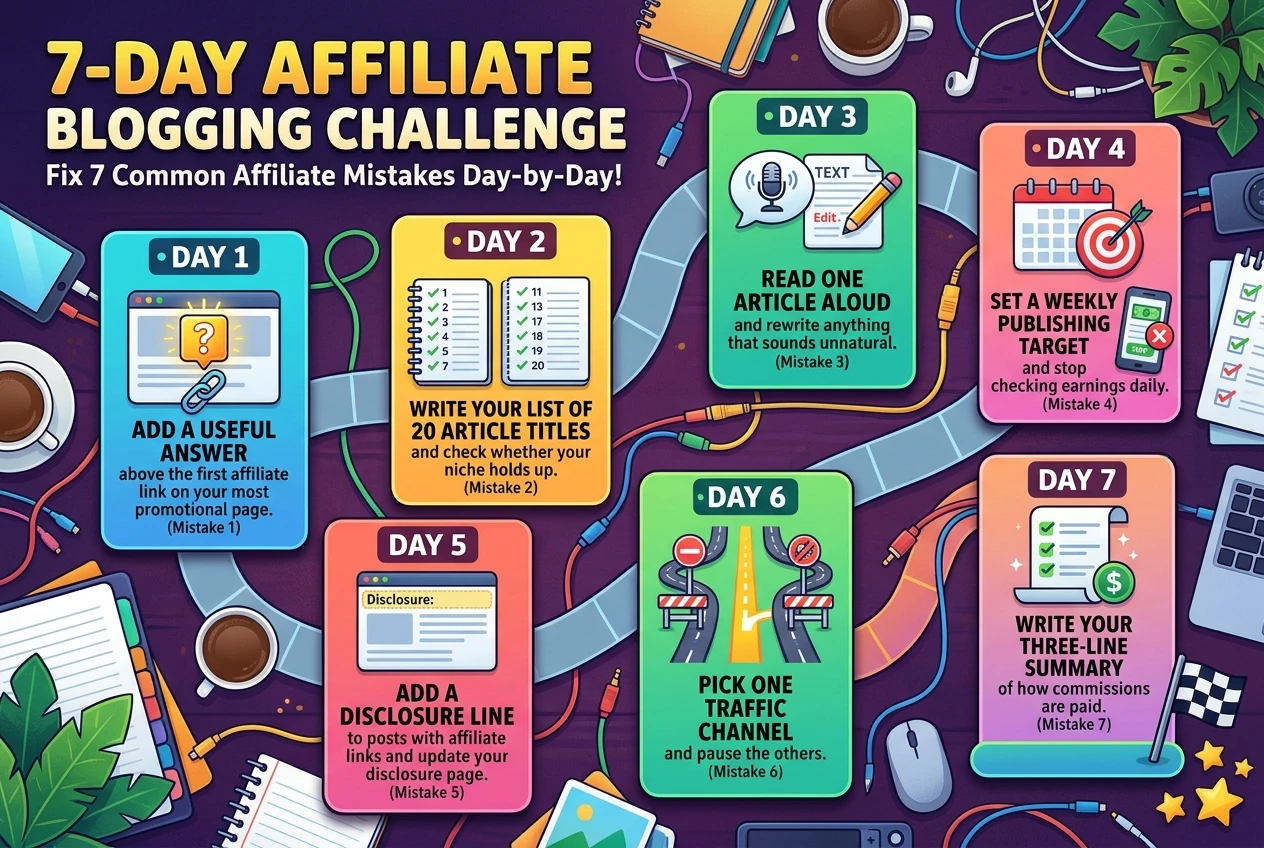
- Day 1: Add a useful answer above the first affiliate link on your most promotional page (Mistake 1).
- Day 2: Write your list of 20 article titles and check whether your niche holds up (Mistake 2).
- Day 3: Read one article aloud and rewrite anything that sounds unnatural (Mistake 3).
- Day 4: Set a weekly publishing target and stop checking earnings daily (Mistake 4).
- Day 5: Add a disclosure line to posts with affiliate links and update your disclosure page (Mistake 5).
- Day 6: Pick one traffic channel and pause the others (Mistake 6).
- Day 7: Write your three-line summary of how commissions are paid (Mistake 7).
At the end of the week, your site is clearer, more honest and easier to keep working on. The point of this checklist is steady progress that you can repeat, and it asks nothing that a beginner can’t do.
If you are still unsure where to put your energy first, read Your First Week Online: What to Do and What to Skip to get back on a clear path, then take a look at how Wealthy Affiliate walks beginners through building a site and earning step by step.