
Most beginners pick affiliate programs by looking at the headline commission number. A program that pays a big amount per sale looks better than one that pays a small amount each month. Over a few months, though, the two can produce very different results, and the difference comes from how the income is shaped.
This article compares the two shapes, recurring affiliate commissions vs one-time commissions, using a simple example you can follow with a calculator. It also covers where recurring income falls short, because it has limits worth knowing before you build around it.
The treadmill problem with one-off affiliate sales
A one-off commission pays you once for each sale you refer. The reader buys, you get paid, and that is the end of that transaction. Nothing more arrives from that customer unless you send them another purchase.
That means every month starts at zero. To earn the same amount in March that you earned in February, you need the same number of new buyers, which means the same amount of content, traffic and persuasion. Stop publishing for a month and the income drops, because last month’s sales do nothing for this month’s total.

One-off programs are not bad. For a high-priced product, a single commission can be substantial. The weakness is that your income depends entirely on your current effort. For someone who has a job, a family or just a limited number of hours each week, that makes the income hard to build on.
What a recurring commission actually is, in plain words
A recurring commission pays you again each billing cycle for as long as the person you referred stays subscribed. You refer someone once. If they pay for a monthly membership, you are paid on that membership each month, until they cancel.

The work you did to earn the referral happens once. The payments continue on their own schedule, and each new referral adds a payment on top of the existing ones.
If you want the mechanics of tracking, approval and payout, how affiliate commissions actually get paid walks through it step by step. This article is about the shape of the income, so we will keep to that.
Watching the two income shapes grow side by side
The numbers below are made up to show the pattern. They do not describe any real program. Imagine two programs:
- Program A (one-off): pays $20 once per sale.
- Program B (recurring): pays $10 per month for each active subscriber.
Say you refer two people per month with either program, for six months.
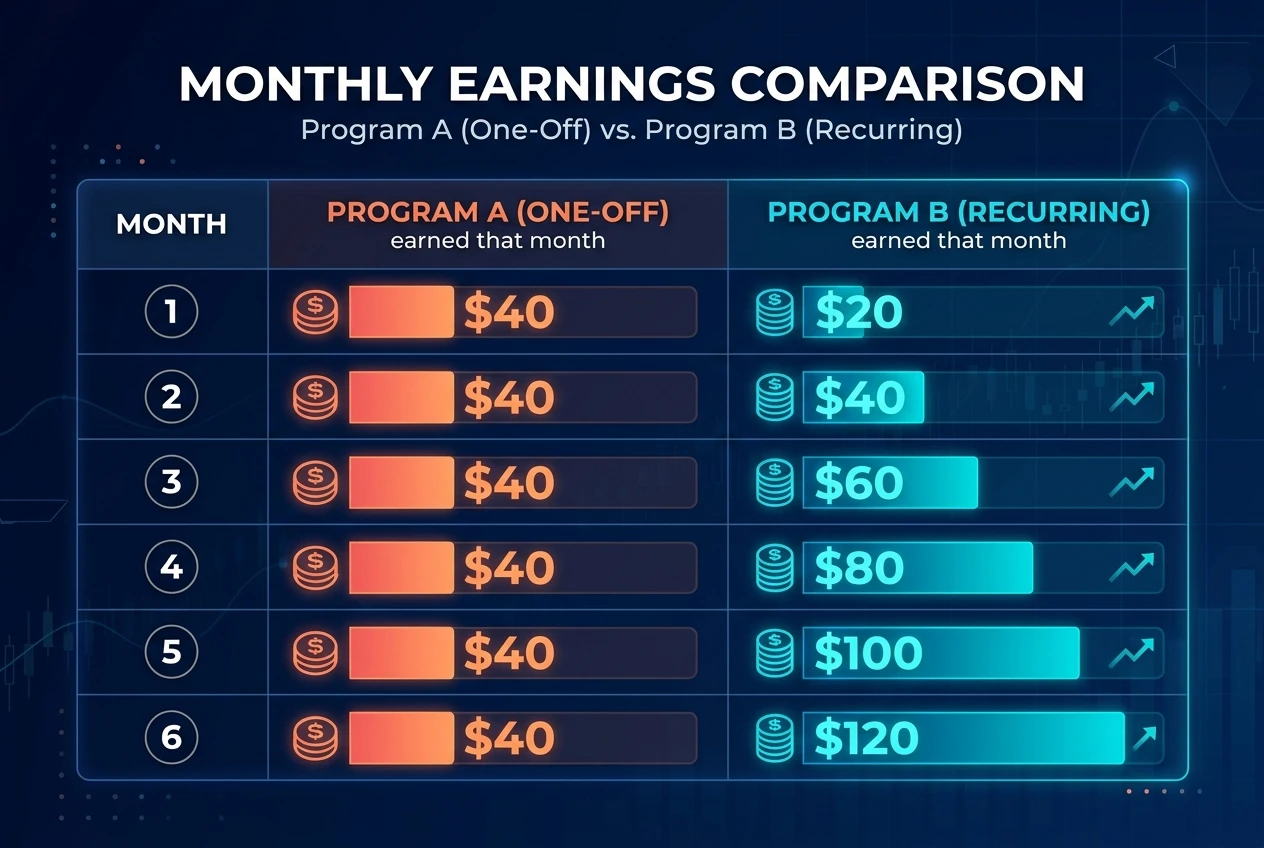
Program A gives you $240 across six months. Program B gives you $420. Month one favors the one-off program, since $40 beats $20, and for a while it looks like the better deal. By month three the recurring line has caught up, and after that it keeps climbing while the other stays flat.
The reason is simple. Program A pays for two referrals each month, always. Program B pays for every referral you have made so far, because the earlier ones are still subscribed. By month six you have twelve active subscribers, each paying you $10.
Your effort in this example was identical in both cases, two referrals a month. Only the payment structure differed.
Why recurring income suits a beginner who is still learning
Beginners usually progress unevenly. You might get two referrals in one month, none in the next, and one after that. This is normal while you are learning to write helpful content, building a site and waiting for search traffic to arrive.

Recurring commissions fit that pattern well, for a few reasons:
- Slow months hurt less. A referral from three months ago may still be paying you, so a quiet month is not a zero month.
- Early work keeps counting. The first article that brings in a referral continues to contribute long after you published it.
- Small numbers still matter. One or two referrals will not change your life, but they give you real evidence that your content can lead someone to act. That evidence is useful when you are still deciding whether to keep going.
- You can plan around it. Income that repeats is easier to forecast than income you must win again each month, even if the forecast is rough.
None of this replaces learning to create content people want to read. If you are still working on that, how to write content that actually helps your reader is a good place to focus, because referrals only come from readers who trust what they find.
What recurring does not mean: the honest limits
Recurring commissions are not guaranteed income, and it is better to know that now.
People cancel. Your commission lasts only as long as the subscription does. Go back to the table: if three of your twelve referrals had cancelled by month six, you would earn $90 that month instead of $120. That is still more than the one-off program paid in the same month, but it shows that the numbers shrink when people leave.
It starts small. In the example, month one paid half of what the one-off program paid. Recurring income rewards patience, and anyone who expects a large payment in the first few weeks will be disappointed.
You still need referrals. Existing subscribers do not replace new ones. The stack grows only if you keep adding people, and it can shrink if you stop and cancellations continue.
Retention depends on fit. A referral stays subscribed when the product is useful to them. If you send the wrong people, for example by overpromising or targeting readers who are not a match, they leave quickly. Honest recommendations produce longer-lasting commissions, and that is a practical reason to be accurate about what you promote, quite apart from the ethics.
One-off programs can still be the right choice. If a product is a single purchase by nature, such as a one-time course or a piece of equipment, a recurring structure does not exist for it. A mix of both is common, and nothing says you must pick only one.
How to tell if a program’s commissions really recur
Marketing pages sometimes use the word “recurring” loosely, so check before you commit. Look for these things in the program’s terms:

- What exactly recurs. Does the commission continue for every billing cycle, or only for a set number of months? Some programs pay for a limited period and then stop.
- What the product’s billing looks like. Recurring commissions need a recurring product, such as a membership or subscription. A one-time purchase cannot pay you monthly.
- What happens on cancellation or refund. Find out whether commissions stop immediately and whether any payment can be reversed.
- The payout threshold and schedule. A program might recur but pay out only once your balance reaches a minimum, which delays when you see money.
- Whether the rules are written down. If you cannot find the terms in plain language, ask the program or look elsewhere.
Write the answers down for each program you are considering. Comparing three or four programs this way takes under an hour and prevents a poor choice that you would only discover after publishing content around it.
How Wealthy Affiliate’s recurring referral commissions fit in
Wealthy Affiliate is a platform for learning to build an online business, with training, website hosting and a community in one place. When you refer someone who joins as a paid member, your referral commission recurs for as long as that person stays subscribed. That is the structure described in the comparison above: refer once, and be paid again each cycle while the membership continues.
It also carries the same limits. If a referral cancels, that commission ends, and the stack grows only as you keep helping new people find the platform. Because you promote something you can explain from the inside, the content you write can be specific and honest about who the platform suits and who it does not.
You can also begin free, which matters for a beginner. You can look around, learn how the platform works and decide for yourself before spending anything. For the exact commission rates and current membership prices, check Wealthy Affiliate’s own pages, since those details can change and are best read at the source.
Your next small step: pick the program before you pick the products
Beginners often start by choosing products to review, then look for programs that sell them. It works better in the other direction. Decide which program you want to build around, confirm that its commissions behave the way you need, and then choose the topics and products that fit.
A simple version of this takes one sitting:
- List three programs you are considering.
- For each, write down whether commissions are one-off or recurring, how long they last, and when payouts happen.
- Pick the one whose structure matches how you can realistically work, whether that is steady posting over many months or occasional bursts.
If you are still deciding what your site is about, how to choose your first niche without overthinking it pairs well with this step, though you only need one link of reading to move forward.
Then take a look at the About page to see what Wealthy Affiliate offers and whether it feels like the right place for you to start. You can begin free and go at your own pace.